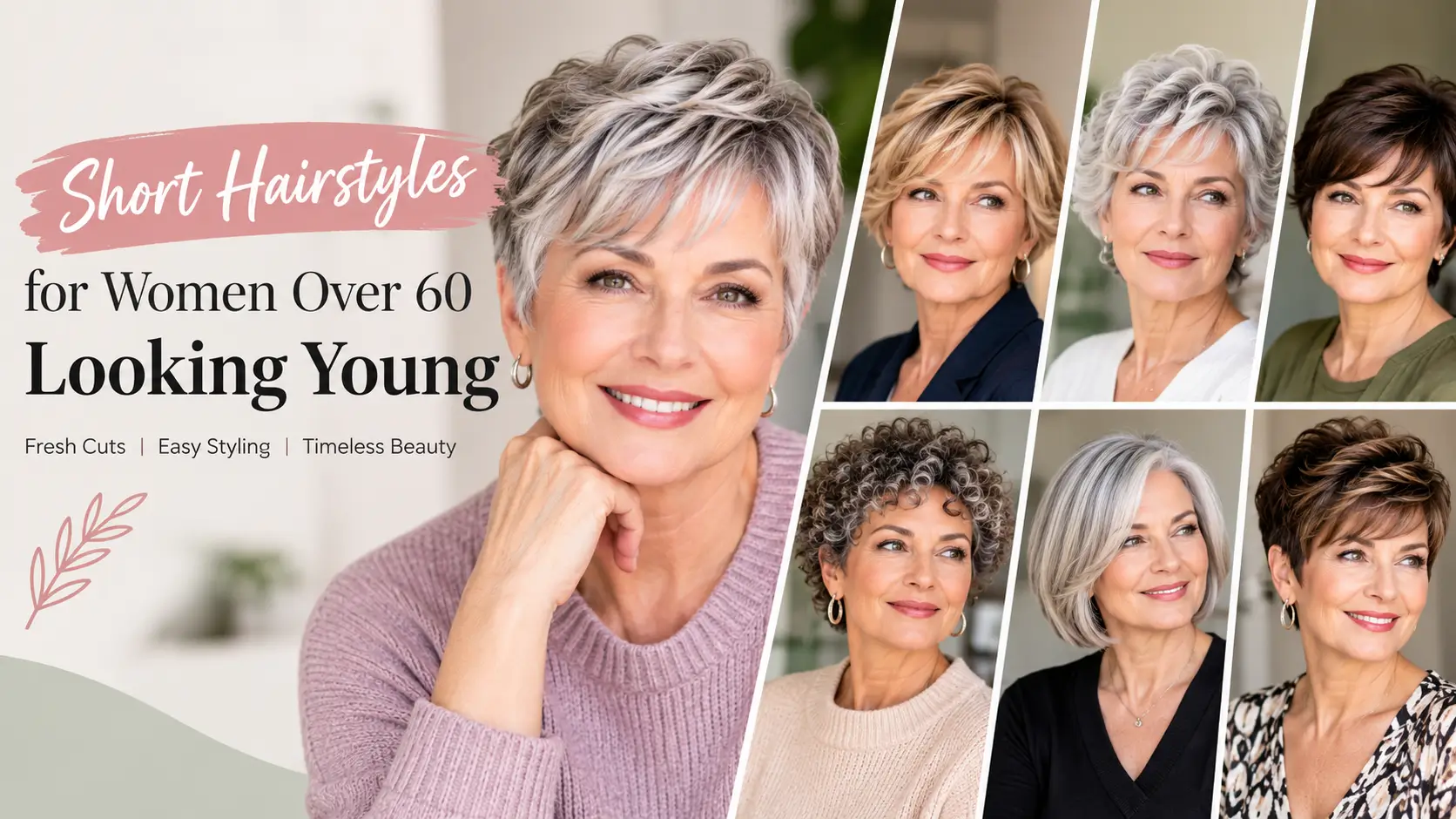
Short Hairstyles for Women Over 60 Looking Young: 12 Flattering Ideas
Choosing a new haircut after 60 can be an opportunity to refresh your appearance, simplify your daily routine, and highlight the features you love most. The right cut can create the appearance of fuller hair, introduce movement around the face, and make styling easier without requiring a dramatic transformation.
The best short hairstyles for women over 60 looking young are not necessarily the shortest cuts or the trendiest designs. They are the styles that work with your natural texture, hair density, face shape, and preferred level of maintenance.
For some women, a textured pixie creates a light, lifted silhouette. Others may prefer a chin-length bob, soft layers, or a curly crop that celebrates their natural texture. There is no universal haircut that makes every woman look younger, but thoughtful shaping can create a fresh, modern, and confident appearance.
This guide compares 12 practical options and explains who each cut may suit, what to consider before choosing it, and how to maintain the result. For more beauty and hairstyle inspiration, explore AbleStyles.
How to Choose a Youthful Short Haircut After 60
Before choosing a picture to take to your stylist, consider four important factors.
Hair texture: Straight, wavy, curly, and coily hair respond differently to layering and length. A cut that looks full on naturally wavy hair may require extra styling on fine, straight strands.
Hair density: Fine hair may benefit from a compact shape and carefully placed layers. Thick hair can need internal layering or weight removal to prevent a bulky silhouette.
Face-framing: Side-swept fringes, soft layers around the cheeks, and carefully positioned volume can help balance individual features. Face shape is a useful starting point, but your personal preferences matter more than strict rules.
Maintenance: Some pixies require frequent salon visits to preserve their shape, while longer bobs can provide more flexibility as they grow. Consider both the time you want to spend styling and how often you are comfortable getting a trim.
With these factors in mind, the following styles offer different combinations of softness, volume, structure, and convenience.
12 Short Hairstyles for Women Over 60 Looking Young
1. Textured Pixie Cut
A textured pixie is a strong option for women who want a short, modern haircut with movement. The sides and back remain relatively close to the head, while slightly longer layers on top create texture and lift.
This style can work particularly well for fine or straight hair that tends to fall flat. Rather than cutting every section to the same length, a stylist can introduce carefully placed layers that create a fuller-looking finish.
Best for: Fine to medium hair, active lifestyles, and women who prefer a short styling routine.
Styling tip: Work a small amount of lightweight styling cream through the crown using your fingertips. Avoid heavy waxes or oils that can weigh fine strands down.
Keep in mind that a pixie is not automatically a wash-and-go haircut. Its shape and your natural growth pattern determine how much daily styling it needs.
2. Soft Layered Bob
A soft layered bob combines the convenience of shorter hair with enough length to frame the face. It usually sits around the chin or jawline, although the exact length can be adjusted to suit your features.
Subtle layers add movement without making the ends appear excessively thin. This balance is useful for women who want more body but are not ready for a very short crop.
The layered bob can also be adapted for straight or wavy hair. A side part creates asymmetry, while a gentle fringe can soften the transition between the forehead and cheekbones.
Best for: Fine to medium hair, women transitioning from longer styles, and those who want a versatile everyday cut.
Styling tip: Blow-dry with a medium round brush, directing the roots upward for gentle volume.
For more ideas based on hair density and everyday maintenance, read our guide to fine hair wash-and-wear haircuts for over 60.
3. Classic Chin-Length Bob
The classic chin-length bob is a timeless choice that can look polished without complicated styling. Its relatively clean outline gives straight hair a defined shape, while the length provides enough coverage around the sides of the face.
For fine hair, a fuller-looking perimeter may be more useful than removing too much weight through the ends. Women with thick hair may prefer a little internal layering to prevent the cut from appearing heavy.
The parting also makes a difference. A center part creates symmetry, while a side part adds a softer, less structured finish.
Best for: Straight or slightly wavy hair, women who prefer neat silhouettes, and those who enjoy a classic appearance.
Styling tip: Use a heat protectant before blow-drying and direct the ends slightly inward for a smooth finish.
Ask your stylist to tailor the length to your jawline and natural hair growth rather than copying a bob photographed on someone with different hair density.
4. Shaggy Pixie
A shaggy pixie combines short sides with uneven, piecey layers through the top. Instead of aiming for a perfectly smooth finish, the haircut relies on natural-looking separation and movement.
This can be a useful option for women who find sleek styles too flat or formal. The textured shape creates a relaxed appearance and can work well with naturally wavy hair or fine strands that hold a little styling product.
However, excessive thinning can make delicate ends look sparse. Ask for texture that preserves enough fullness where you need it.
Best for: Fine to medium hair, women who like a relaxed finish, and those comfortable using a little styling product.
Styling tip: Apply a lightweight texturizing cream to damp or dry hair and arrange individual sections with your fingers.
If you wear glasses, consider how the fringe and side layers will sit against your frames. Our guide to choppy pixie haircuts for older ladies with glasses offers more frame-friendly inspiration.
5. Short Wavy Bob
A short wavy bob works with the natural movement of the hair instead of requiring every strand to lie perfectly straight. Depending on your curl pattern, it may sit between the cheekbones and neckline.
The advantage is versatility. Gentle waves can soften a sharply defined outline, and a slightly irregular texture can create a relaxed, contemporary finish.
Women with naturally straight hair can create similar movement using a curling wand, but those who want minimal daily styling should consider how their hair behaves after washing.
Best for: Naturally wavy hair, medium-density strands, and women who enjoy soft volume.
Styling tip: Apply a light curl-enhancing cream to damp hair, scrunch gently, and let it air-dry or use a diffuser on a suitable setting.
Avoid brushing through finished waves too aggressively, as this can separate the texture and create unwanted frizz.
6. Tapered Natural Crop
A tapered crop keeps the sides and nape shorter while leaving slightly more length through the top. It is particularly adaptable for curly, coily, and natural-textured hair.
The shape creates a clear outline without forcing the hair into a completely uniform style. A stylist can adjust the taper to preserve fullness at the crown or reduce bulk around the sides.
This haircut can also complement natural silver, salt-and-pepper, or dark hair because its shape remains the main feature of the look.
Best for: Curly and coily hair, women who prefer structured short cuts, and anyone who wants to work with their natural texture.
Styling tip: Use a moisturizing leave-in product or curl cream suited to your hair. Focus on gentle detangling and avoid excessive heat when possible.
The main trade-off is upkeep: a clean taper can require regular reshaping, especially if you prefer a sharp outline.
7. Side-Swept Pixie
A side-swept pixie retains a little additional length at the front, allowing the fringe to move diagonally across the forehead. This detail gives the haircut flexibility and can soften the appearance of a strongly defined hairline.
It is a practical alternative for women who like short hair but do not want a very exposed forehead or an entirely uniform crop. The longer front section also provides a small amount of styling variation.
The fringe should be tailored to your hair's natural direction. Cowlicks and strong growth patterns can influence whether it falls smoothly or needs extra styling.
Best for: Fine or medium hair, women who prefer soft face-framing, and those who want a pixie with a little versatility.
Styling tip: Blow-dry the front section in the direction you want it to fall, using your fingers or a small brush.
Keep the fringe long enough to move freely without falling repeatedly into your eyes.
8. Curly Pixie
A curly pixie highlights natural curl rather than hiding it beneath a smooth finish. The stylist shapes the silhouette so curls have enough room to form without becoming too heavy at the sides or crown.
This distinction is especially important because curly hair can shrink considerably as it dries. Your stylist should consider the difference between its wet and dry length before cutting.
When balanced correctly, a curly pixie can offer visible texture and a lively shape without requiring daily heat styling.
Best for: Naturally curly hair, women who want a shorter routine, and those who prefer to celebrate their curl pattern.
Styling tip: Apply a suitable leave-in conditioner followed by a lightweight curl-defining product. Scrunch gently and avoid touching the hair excessively while it dries.
For a successful result, communicate whether you prefer defined curls, a softer silhouette, or a more textured finish.
9. Short A-Line Bob
An A-line bob is typically shorter at the back and gradually longer toward the front. The angled outline gives the haircut definition while retaining some movement around the face.
This style can be appealing for women who want something more structured than a traditional rounded bob. On straight hair, the angle is usually easier to see. With wavy hair, the same shape may appear softer and more relaxed.
The degree of graduation matters. A dramatic angle creates a stronger statement, while a subtle one offers a quieter, more versatile result.
Best for: Straight or slightly wavy hair, women who like defined shapes, and those seeking an alternative to a standard bob.
Styling tip: Use a smoothing product sparingly and direct the ends forward to emphasize the angled outline.
Ask your stylist to consider the back-of-head shape and your natural hairline so the shorter section sits comfortably.
10. Short Shag With Wispy Bangs
A short shag uses layers to create a deliberately textured silhouette. Adding wispy bangs connects the front of the haircut to the rest of the shape without creating a heavy, blunt line.
This option can suit women who prefer hair that feels relaxed rather than perfectly arranged. It may also give fine or medium hair a more dimensional appearance when the layers are positioned carefully.
The biggest consideration is density. Too many short layers can make fine ends look thinner, while thick hair may need more internal shaping to control bulk.
Best for: Fine to medium hair, natural waves, and women who like a casual, expressive style.
Styling tip: Apply a light mousse to damp hair and let the layers fall naturally. Use a small amount of texturizing product only where extra definition is needed.
The fringe should be easy to move aside on days when you prefer a different look.
11. Rounded Silver Bob
A rounded bob emphasizes a smooth, curved outline around the head. It can be particularly striking with naturally silver, white, or salt-and-pepper hair because the clean shape draws attention to the cut itself.
This style does not require you to color your hair or disguise gray strands. Instead, it allows the haircut and your natural color to work together.
The shape can be customized with a soft side part, subtle layering, or a slightly longer front. For finer hair, preserving fullness at the ends is often more useful than adding numerous short layers.
Best for: Straight to slightly wavy hair, women embracing their natural gray, and those who prefer a polished appearance.
Styling tip: Use a heat protectant and a round brush if you want a smooth finish. Choose a lightweight conditioner that does not leave your roots feeling heavy.
Regular trims can help maintain the rounded outline as the hair grows.
12. Textured Crop With a Soft Fringe
A textured crop with a soft fringe offers the convenience of short hair while leaving enough length around the forehead to adjust the overall shape.
The layers can be kept subtle for a neat finish or made more pronounced for a piecey, casual look. This makes the cut easier to personalize than a very short, uniform crop.
It can be especially useful for women who want to refresh their appearance without committing to a dramatic pixie. The fringe also gives the stylist another way to balance the proportions of the haircut.
Best for: Fine to medium hair, women who prefer short styling routines, and those seeking a modern but understated look.
Styling tip: Use your fingers to arrange the fringe rather than trying to create a perfectly fixed shape. A little movement usually gives the haircut a softer finish.
Before cutting, decide whether you want the fringe to sit above the eyebrows, along the eyebrows, or sweep to one side.
Which Short Haircut Works Best for Your Hair Type?
Choosing among these styles becomes easier when you start with your hair's natural characteristics.
For fine or thinning hair: Consider a textured pixie, a classic bob with a fuller perimeter, or a short crop with restrained layering. Avoid removing too much weight from already delicate ends. The goal is to create a shape that makes the hair appear balanced, not to promise that a haircut will increase actual hair density.
For thick hair: A layered bob, short shag, or A-line bob may help control bulk while preserving movement. Ask your stylist where weight should be removed so the outline remains intentional rather than overly wide.
For naturally curly or coily hair: A curly pixie or tapered natural crop can work with your existing texture. Choose a stylist who understands shrinkage, curl placement, and how your hair behaves when dry.
For straight hair: A classic bob, rounded silver bob, or side-swept pixie can provide a clearly defined shape. Soft layering or a change in parting can add movement without sacrificing too much fullness.
For women who wear glasses: Pay particular attention to the temples, fringe, and side sections. Hair should sit comfortably around your frames rather than constantly catching on them.
The best match is the cut that suits your texture and routine, not simply the one that photographs well on another person.
How to Maintain a Fresh, Youthful Appearance
Even an excellent haircut can become difficult to manage if its upkeep does not fit your routine.
Start with a realistic trimming schedule. Very short pixies and sharply tapered cuts often need more frequent reshaping than a slightly longer bob. Ask your stylist when the haircut is likely to lose its intended silhouette and plan accordingly.
Use products that match your hair density. Fine hair may respond better to lightweight mousse or root-lifting products, while curly and coily hair may need more moisture and curl definition. Applying several heavy products at once can make the hair feel coated or flat.
Reduce unnecessary heat exposure. When blow-drying or using hot tools, choose a suitable temperature and apply a heat protectant. A haircut with natural movement may need less heat than a sleek style that depends on a smooth finish.
Finally, consider your parting and everyday styling habits. A small change in direction, a softer fringe, or a little lift at the crown can refresh the appearance without changing the entire haircut.
If you are growing out a pixie or tracking length between trims, you can use the AbleStyles hair growth calculator. A separate browser-based hair growth calculator is also available for estimating growth over time.
What to Tell Your Hairstylist Before Getting a Short Cut
Bring two or three reference pictures, but explain what you like about each one. You might prefer the crown volume in one photo, the fringe in another, and the length around the ears in a third.
Be specific about your priorities. For example, tell your stylist that you want a cut that air-dries reasonably well, keeps fine ends looking full, or leaves enough length at the front to sweep aside.
Discuss the trade-offs before committing to a very short style. A pixie can reduce daily styling time but may require more frequent salon visits. A bob provides more length for variation but might need brushing or drying to maintain its outline.
If you are transitioning from long hair, you do not have to make a dramatic change in one appointment. A shorter bob can be an intermediate step before trying a pixie.
The most useful reference photograph is one that resembles your hair texture and density, not just your preferred overall aesthetic.
Frequently Asked Questions
What is the most flattering short haircut for a woman over 60?
There is no single best haircut for every woman. A layered bob offers versatility, a textured pixie can suit women who prefer short hair, and a curly crop can highlight natural texture. Your hair density, face shape, styling habits, and personal preferences should guide the decision.
Do short hairstyles make women over 60 look younger?
A flattering short haircut can create a fresh, modern appearance by introducing movement, balancing proportions, and making the hair easier to style. However, no haircut guarantees a particular age-related result. Choose a style that makes you feel comfortable and confident.
Which short haircuts work best for fine hair after 60?
A textured pixie, chin-length bob, or soft crop can work well when the shape is designed to preserve fullness. Excessive thinning or too many layers may leave delicate ends looking sparse, so ask your stylist to assess your hair before removing weight.
Are bangs a good choice for women over 60?
Yes. Wispy, side-swept, or softly textured bangs can complement short haircuts without creating a heavy line. Their success depends on hair growth patterns, forehead proportions, and how much daily styling you want to do.
Which short hairstyles are easiest to maintain?
A simple crop or a well-shaped textured pixie can be relatively quick to style, while a bob may offer more flexibility as it grows. Remember that short cuts can require frequent trims even when they need little daily styling.
Explore More Hairstyle Inspiration
Your ideal short haircut should fit your lifestyle as well as your appearance. For additional ideas, explore these related resources:
- 20 Easy Hairstyles for Long Hair: Useful if you are comparing a shorter cut with the styling flexibility of longer hair.
- Easy Hairstyles With Extensions: Inspiration for experimenting with added length or fullness when appropriate.
- Medium-Length Boudoir Hairstyles: A separate collection of occasion-focused looks for photography and special events.
- Winter Men's Haircuts: Seasonal haircut inspiration for men in your household.
Visit AbleStyles.com for more hairstyle guides, or use the hair growth tools above if you are planning to grow out a short cut.
Final Thoughts
The most effective short hairstyles for women over 60 looking young are the ones that work with your natural hair rather than against it. A textured pixie can add visual movement, a classic bob can provide a polished outline, and a curly crop can celebrate the texture you already have.
Focus on three things before making your choice: what suits your hair, how much maintenance you want, and which features you would like the haircut to highlight. With those priorities clear, you can choose a style that feels modern, manageable, and genuinely your own.